
Cam Tokens Explained: How Much Private Shows, Tips, and Group Shows Really Cost
Last updated: June 2026
- Cam tokens are platform credits that obscure real-dollar costs. A “60 tokens per minute” private show can mean $3.30–$6.00 per minute depending on the package you bought.
- Private shows are the fastest budget burner (average real spend: $50–$150 per session). Group shows cost less to enter but can escalate through competitive tipping. Public chat tips look harmless but account for roughly 40% of all token spending.
- The single best money move: convert every token price to dollars before you click, set a hard cap, and never reload mid-session.
Cam tokens are simple on the surface. You buy platform credits, then use them for tips, private shows, and group shows. The real issue — and it’s one I’ve watched play out across every major platform for years — is that tokens make spending feel smaller than it actually is. That disconnect is why so many users lose track of the real cost faster than they’d expect.
«I’ve spent years tracking how live cam platforms structure tokens, pricing, and room access, and the pattern is consistent: the less visible the real-dollar cost feels, the easier it is for users to overspend without noticing it in the moment.»
— Tony R., Chococams editorial team
If you use cam sites regularly, this is the question that actually matters: what do those tokens buy, and which format burns through them fastest? Research on token-based payment systems shows that abstract payment methods reduce the “pain of paying” and can push spending 15–20% higher than direct-currency payments because the cost feels less immediate. Users experience roughly 30% less psychological discomfort when paying with tokens compared to direct cash transactions. That’s the mechanism behind the overspending pattern, and it’s remarkably consistent across platforms.
This article breaks down how cam token pricing works, how private show and group show costs usually build, and how to estimate spending before you click into a room. A note: this is adult-industry guidance, not financial or legal advice. Platform rules, token conversion rates, and billing structures vary by site and can change without notice. The information here is general in nature and doesn’t replace professional consultation on financial matters.
What cam tokens are and how token pricing works
Cam tokens are the in-platform currency most cam sites use instead of charging dollars directly for every action. The webcam industry is valued at approximately $10.97 billion in 2025, with projections reaching $20.95 billion by 2030 at a CAGR of 13.8%. Tokens turn real money into platform credits — and that makes spending more flexible for the site but considerably less visible for the user.
On most platforms, users buy token packages first and then spend those tokens across different interactions. Webcam token systems function as a form of “financial abstraction,” where the conversion step separates real money from the later purchase decision. The webcam token economy reached $7.8 billion in transaction volume in 2023, with 2.5 billion tokens traded across the top five sites. Those numbers aren’t abstract. They represent real dollars flowing through a system specifically designed to make each transaction feel lighter than it is.
In practice, this means the displayed number in a room is often not the same thing as an immediately felt dollar amount. A room may show 60 tokens per minute, 100 tokens to join, or 25 tokens to trigger a menu action. That feels lighter than seeing direct dollar pricing every time. And that’s the point.
Token-to-dollar conversion: what tokens actually cost in real money
This is the piece most guides skip, and it’s the single most important thing to understand before you spend anything. Token prices depend on the package size you buy, and the difference matters more than most users realize.
Here’s a realistic breakdown based on common platform pricing:
| Package price (USD) | Tokens received | Cost per token | Cost per minute at 60 tk/min rate |
|---|---|---|---|
| $10 | ~100 tokens | $0.10 | $6.00/min |
| $20 | ~200 tokens | $0.10 | $6.00/min |
| $50 | ~550 tokens | $0.091 | $5.45/min |
| $100 | ~1,100 tokens | $0.091 | $5.45/min |
| $160 | ~2,025 tokens | $0.079 | $4.74/min |
The exact numbers vary by platform, but the pattern is universal: larger packages reduce the effective cost per token by 17–21%, which means every minute of every private show gets cheaper on paper. If you buy 100 tokens for $10, a 60-token-per-minute show costs you $6.00 per minute in real money. If you buy the largest package, the same show costs roughly $4.74 per minute. Over a 15-minute session, that difference is almost $19. Not trivial.
Platforms use this “decoy pricing” structure deliberately: packages with more tokens create an illusion of better value and encourage higher upfront purchases. That doesn’t automatically mean buying big is smarter — it only makes sense if you already know your spending limit and won’t treat a larger balance as play money. I’ve seen users load $160 in tokens “for the discount” and then burn through the entire balance in a single evening because the number in their account felt like house money. The discount saved them $19. The behaviour cost them $120 extra.
The conversion rates listed above are approximations. Actual prices vary by platform. On some sites, 1 token can range from $0.05 to $0.11 depending on the package and any promotions running at the time. Always check the specific platform’s token shop before buying.
Glossary
| Term | Definition |
|---|---|
| Tokens | Platform credits bought with real money and used inside cam sites for paid interactions. |
| Pricing | The rate structure behind tips, private chats, group access, and premium actions. |
| Private | A one-on-one or limited-access paid session, often billed per minute. |
| Group | A paid room with multiple viewers sharing access to the same show. |
| Tip | A token payment sent to a model, often in public chat or during premium sessions. |
| Public chat | An open room that is usually free to enter but often driven by tips and paid goals. |
| Private chat | A paid interaction with tighter access, usually with higher cost and more direct attention. |
| Fan Club | A recurring monthly subscription to a specific model, usually $9.99–$14.99/month, providing badges, exclusive content, and priority access. |
| Locked Content | Photos, videos, or messages behind a paywall that require a one-time token payment to unlock. |
| Bulk Discount | The reduced per-token cost you get when purchasing a larger token package upfront. |
A pattern I’ve noticed across major platforms over the years: beginners focus on the package purchase, while experienced users focus on burn rate. That shift matters because the package price tells you what you loaded, but the burn rate tells you how fast the money disappears. And it’s the burn rate that determines whether you walk away satisfied or wondering where $80 went.
Why tokens can make spending feel less visible
Tokens reduce spending visibility because they replace direct-dollar decisions with abstract units. That extra conversion layer is exactly what makes cam spending feel softer in the moment — and harder to track after the fact.
Users experience materially less psychological discomfort with abstract token payments than with direct cash-style payments, and that effect is linked to lower spending awareness and higher overspending risk. Users can spend 15–20% more with abstract payment systems than with direct-currency spending. Think about that for a second. The same person, the same session, the same content — but the payment format alone can push the total up by a fifth.
A simple example explains the mechanism. Spending 50 tokens sounds smaller than spending $5.50 in actual cash, even though the real-money equivalent is identical. That’s why token systems work so well for micro-payments like chat tips, menu triggers, and per-minute private sessions. Each individual transaction feels insignificant. The session total doesn’t.
From my experience reviewing cam platforms, this effect gets stronger when a site uses:
- large token denominations,
- pre-set tip buttons (those convenient round numbers),
- charm-style numbers like 99 or 199,
- and continuous deductions instead of one visible charge.
I’ve tested rooms where the listed private rate looked perfectly manageable at first glance. Then I converted the rate into a 10-minute and 20-minute dollar estimate before entering. The total was high enough that the room no longer felt “cheap,” even though the token rate initially looked harmless. That ten-second calculation changed the decision entirely.
How users usually get and use tokens on cam sites
Users usually get tokens by buying a package from the platform, then spend them across public tips, private shows, group shows, and add-on interactions. The more actions a site offers inside one session, the easier it is to lose track of total spending.
Token packages are often presented in ways that reward larger purchases through better apparent value per token. That doesn’t always mean better spending control. In many cases, it means users preload more than they planned and then treat the balance as play money — a pattern I’ve seen repeat across Chaturbate, Stripchat, BongaCams, and nearly every other major platform.
Typical token use on cam sites includes:
- tipping in public chat,
- entering a private show,
- joining a group show,
- paying per minute for exclusive time,
- unlocking premium actions or requests,
- unlocking locked photos, videos, or messages,
- and sometimes paying for model-specific menu items.
Public-chat tipping accounts for roughly 40% of token expenditure, private shows for 35%, and group shows for 25% across major platforms. Those shares matter because they reveal where users usually bleed tokens fastest: not only in one-on-one time, but also in repeated public and group interactions that feel casual but add up relentlessly.
What you can use tokens for on cam sites
Before diving into the cost mechanics of each format, it helps to see the full picture of where tokens actually go. Most users think of tokens as “the thing you spend in private shows,” but the reality is broader — and understanding the full range of token uses is what separates someone who controls their spending from someone who doesn’t.
Tokens fuel three main interaction layers on cam sites: public tipping, paid show access (private and group), and premium add-ons. Each layer has its own spending dynamics, and each one can quietly drain a balance if you’re not paying attention.
Tips in public chat and why small payments add up
Public chat is usually free to enter, but it is rarely free to participate meaningfully. Small tips accumulate fast because they’re frequent, easy, and socially visible — you see other users tipping, the model reacts, and the room energy shifts.
Public tipping functions as an impulse-driven micro-transaction ecosystem. Each individual payment feels insignificant, but together they form roughly 40% of total token expenditure across major platforms. Users often start with low token amounts and then gradually increase tip size over time as the session builds momentum.
That matches what I’ve seen across sites like Chaturbate, Stripchat, and BongaCams. A room can feel free because entry costs nothing, but once you start tipping for attention, menu actions, or room goals, the spending pattern changes. You’re no longer browsing. You’re feeding a loop.
Here’s what that really looks like in dollars:
You drop 25 tokens to say hi. Then 50 for a menu item. The model responds, so you send another 25. Before any private show even starts, you’re down roughly $8–$11 depending on your token package. Users can underestimate public-room spending by 50–70% because the payments are fragmented and no single tip feels expensive. It’s the accumulation that gets you.
A common user mistake is treating each tip as isolated. It isn’t. Ten small tips over thirty minutes can easily cost more than one planned group entry. I’ve tracked sessions where a user’s public tipping exceeded what a 10-minute private show would have cost — and they never even entered a paid room.
Private shows, group shows, and other paid interactions
Beyond public tipping, tokens unlock the paid tiers of cam interaction. Private shows are the most direct — you pay per minute for one-on-one (or sometimes exclusive) access to a model. Group shows offer a shared-access alternative at a lower entry point. And then there’s the layer most users don’t budget for: premium interactions within any of these formats.
Premium interactions include things like specific requests during a private show, interactive toy control (Lovense-enabled rooms are increasingly common), spy mode access on some platforms, and model-specific menu items that carry their own token price. These aren’t always expensive individually, but they stack on top of the base cost of whatever room you’re already in.
The key distinction: the room fee gets you in the door. Everything after that — tips, requests, toy control, locked content — is a separate spending layer. Users who budget only for the room fee consistently underestimate their total session cost.
How private show pricing usually works
Private show pricing usually works on a per-minute basis, with the model or platform setting the token rate. The final total depends on rate, session length, and any extra paid actions added during the show.
This is the format most likely to surprise users on cost because it combines continuous billing with rising engagement. Private shows typically range from 30 to 200 tokens per minute, depending on platform and creator positioning. That’s a wide range, and it means two private shows on the same site can cost dramatically different amounts.
Here’s what those rates actually mean in real dollars, depending on the token package you bought:
| Private rate (tokens/min) | Cost/min ($0.10/token) | Cost/min ($0.079/token) | 15-min session (small pkg) | 15-min session (large pkg) |
|---|---|---|---|---|
| 30 tk/min | $3.00 | $2.37 | $45.00 | $35.55 |
| 60 tk/min | $6.00 | $4.74 | $90.00 | $71.10 |
| 90 tk/min | $9.00 | $7.11 | $135.00 | $106.65 |
| 120 tk/min | $12.00 | $9.48 | $180.00 | $142.20 |
The difference between buying the smallest and largest token package can save you $19–$38 on a single 15-minute private session. This is why the bulk discount math matters — but only if you’ve already decided on a spending cap.
Platform pricing examples
Rates vary by platform. Here are realistic ranges based on commonly visible public pricing:
Chaturbate: Private shows typically range from 30 to 90 tokens per minute. A 10-minute session at 60 tk/min will realistically cost $30–$60 depending on your token package. Tokens cost roughly $0.08–$0.11 each.
Stripchat: Private chat runs approximately 25–80 tokens per minute, with higher pricing for exclusive sessions where no one else can spy. A 15-minute private interaction may range around $40–$75 depending on session type and additional spending.
BongaCams: Private shows generally cost 30–120 tokens per minute, with the token economy structured so that 1 token ≈ $0.05–$0.09 depending on purchase size.
These are broad estimates. The actual cost depends on the specific model, the token package you purchased, and whether you add tips or premium requests during the session.
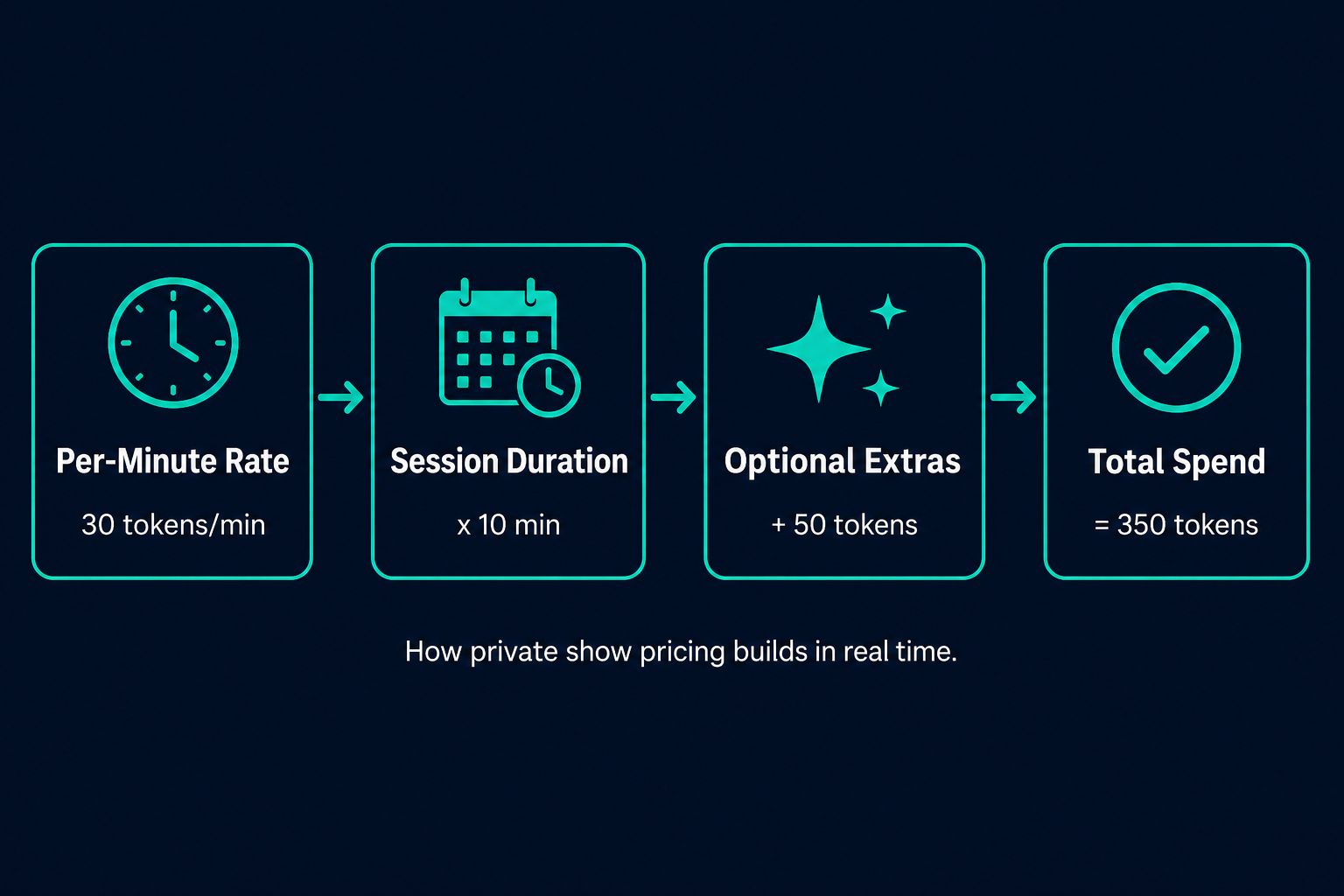
- User sees the per-minute token rate.
- User starts the private show.
- Tokens are deducted continuously as time passes.
- Extra requests or premium actions may add more cost.
- Total spending often ends higher than the user expected at entry.
Per-minute rates and session length
Per-minute rates are the core driver of private show cost. Session length is the force multiplier. And it’s the multiplier that catches people off guard.
Users often enter private sessions expecting 15–20 minutes, but average private sessions frequently stretch to 25–45 minutes, with users spending 40–60% more time than planned. That single finding explains a large part of unexpected private spending. The session gets engaging, the conversation flows, and suddenly you’ve been in the room twice as long as you intended.
Here’s the logic in plain terms:
| Private rate | 10 minutes | 20 minutes | 30 minutes |
|---|---|---|---|
| 50 tokens/min | 500 tokens | 1,000 tokens | 1,500 tokens |
| 100 tokens/min | 1,000 tokens | 2,000 tokens | 3,000 tokens |
| 200 tokens/min | 2,000 tokens | 4,000 tokens | 6,000 tokens |
The table doesn’t include add-ons, extra tips, or premium requests. It only shows how time alone changes cost. And that’s the part most users underestimate.
From my experience, users who look only at the per-minute rate miss the real question. The better question is: how long do private sessions like this usually last once the room gets engaging? Because the answer is almost always “longer than you planned.”
Why private shows often cost more than expected
Private shows often cost more than expected because the user focuses on the rate, not the pattern of escalation. The meter keeps running while attention, customization, and momentum push the session longer.
Users can underestimate private show costs by 35–50%, and that gap is linked to token denomination effects, gradual billing, and the tendency to keep spending once the session has already started. Average private expenditures land in the $50 to $150 range, even when users enter expecting $25 to $75.
This is where the private format differs fundamentally from public browsing. In a private room:
- time is always costing you,
- emotional engagement builds faster,
- and extra offers can appear after you’re already committed.
The danger isn’t minute one. Minute one is charming. The danger is minute seven, minute eleven, minute fourteen — when your brain is no longer doing arithmetic because arithmetic would make the fantasy feel like a phone bill. That’s the private-show drift. I’ve watched it happen in my own test sessions, and honestly, recognizing it doesn’t make you immune. It just makes you faster at catching it.
In one platform review cycle, I tracked a private room with a moderate posted rate. I mapped the likely spend at 10, 20, and 30 minutes and then added common extras. What looked like a mid-priced private session became a premium spend once time drift and add-ons were included. The posted rate was accurate. The final bill was not what the posted rate suggested.
How group shows are priced and why they can feel cheaper
Group shows are usually priced with a lower entry barrier than private shows, which is why they often feel cheaper at first. The catch is that lower entry doesn’t always mean lower total spend.
Group shows use a shared-participation model with entry fees commonly ranging from 100 to 500 tokens (roughly $8–$50 depending on your package), depending on the room and model. That range is wide enough that some group entries cost less than five minutes of a private show, while others approach the price of a short private session.
How group shows differ from private shows
Group shows differ from private shows because access is shared instead of one-on-one. You pay less to get in, but you also get less direct control and less guaranteed attention.
That trade-off is the core value difference. A private show buys access to focused interaction. A group show buys partial access in a room where many users may be trying to influence the same session. Neither is inherently better — they serve different goals.
In practical terms:
- private usually costs more per minute,
- group usually costs less to enter,
- private offers more direct interaction,
- group often works better for observation or lower-risk spending.
For many users, group shows are the better value if the goal is variety, lower initial commitment, or passive enjoyment. Private makes more sense when direct, personalized interaction is the point of paying. Knowing which one you actually want before you enter saves both tokens and disappointment.
When group shows still become expensive
Group shows become expensive when users keep re-entering, keep tipping, or chase attention in a competitive room. The entry fee is only one layer of the bill.
Users in group settings can spend about 25% more than planned because of competitive dynamics, and many who enter planning to watch still add 200–500 tokens during the session through premium participation and tips. That’s the social pressure element — when you see other users tipping and getting reactions, the urge to match or exceed them is real.
This is the pattern I usually warn users about. A group room feels controlled because you can see the entry price. Then the room starts moving:
- someone else tips big,
- the model reacts,
- premium options open,
- the group gets more active,
- and the initial “cheap” room becomes a spending contest.
The entry fee told you the floor. It didn’t tell you the ceiling.
Private vs group vs public chat: what really costs more
Private usually has the highest burn rate, public chat has the sneakiest accumulation, and group shows sit in the middle with lower entry but real upsell risk. The cheapest format depends less on the room label and more on how you behave inside it. You can compare formats across different cam platforms to see how pricing structures differ in practice.
That distinction matters more than most comparisons acknowledge. A disciplined public user may spend nothing. An impulsive public user can burn through tokens faster than planned. A short private show can be efficient. A drifting private session can become the most expensive choice on the page. Same formats, wildly different outcomes.
| Format | Entry threshold | Main payment model | Spending control | Typical cost growth |
|---|---|---|---|---|
| Public chat | Usually free | Tips and paid room actions | Low if tipping is impulsive | Slow at first, then accumulates |
| Group shows | Low to moderate ($8–$50) | Entry fee + tips/add-ons | Moderate | Often rises through extra participation |
| Private shows | Moderate to high ($3–$12/min) | Per-minute billing + extras | Highest visibility, but high burn rate | Fast and continuous |
Public chat: free to enter, but tip-driven
Public chat is free to enter on many sites, but it’s not free if you want interaction. The spending model depends on tips, and that can hide the real total better than an upfront room fee ever could.
Roughly 95% of users begin in public chat, where small tips often range from 5 to 50 tokens each and stack over time. Users can underestimate public-room spending by 50–70% because the payments are fragmented — no single tip triggers caution, but the session total tells a different story.
That lines up with what I see in room behaviour. Public chat is where users feel safest because they can enter without commitment. It’s also where they often stop measuring spend carefully, precisely because it doesn’t feel like a “paid” environment. The irony is hard to miss.
Which format gives more control over spending
Private can offer the clearest cost tracking if you set a time limit before entering. Group offers moderate control. Public chat usually offers the least control if your tipping is reactive rather than planned.
Users who establish token limits before private sessions are about 60% more successful at controlling their total expenditure. That makes sense because private puts the burn rate right in front of you — you can see the meter. Public rooms hide the same problem in smaller, less visible pieces.
If budget control is the priority:
- Public works only if you avoid impulse tipping entirely.
- Group works if you treat the entry fee as the total cap and resist follow-up tips.
- Private works if you set both a token limit and a hard time stop before entering.
Hidden costs: fan clubs, locked content, and recurring charges
This is the spending layer most cam guides ignore completely, and it’s one of the easiest ways to lose money without noticing.
Fan clubs and monthly subscriptions
Fan clubs are recurring monthly subscriptions tied to a specific model. They typically cost $9.99–$14.99 per month and offer perks like badges, exclusive content, member-only streams, and priority messaging. The problem isn’t any single subscription — it’s the stacking.
One fan club: $9.99/month. Manageable. Three fan clubs: $29.97/month. Still maybe fine. Five fan clubs plus a site premium membership: $62.94/month. That’s $755 a year, and most of it is probably for things you stopped using weeks ago.
Fan clubs don’t feel like spending because there’s no visible meter running. They feel like access — a badge, a velvet rope, a way to be something more than a random username. But unused fan clubs become ghost bills: charges that keep hitting your card long after the moment has passed.
A smart rule before subscribing to any fan club: will I use this more than once this month? If yes, it might be worth it. If no, you’re paying for the feeling of being preferred, not actual interaction. Different thing.
Locked content: photos, videos, and impulse purchases
Locked content — paywalled photos, videos, premium galleries, or exclusive messages — can be a clean, efficient purchase. You see the price, you buy it, you get the content. No meter running, no time drift. Straightforward.
The catch is timing. Locked content usually appears after you’re already warmed up. You’ve already tipped, already watched, already started feeling invested. Then comes the locked message, the exclusive clip, the “you’ll like this” prompt. This is where the “might as well” purchase happens — and “might as well” is one of the most expensive phrases in the cam economy.
Before buying locked content, ask one question: would I buy this cold? If you saw this offer before entering the room, before tipping, before any engagement — would you still pay? If yes, buy it. If no, you may not want the content. You may just want the session to feel complete. Different motivation, same checkout button.
The ghost bill audit
Once a month, check every recurring charge tied to your card from adult platforms. This includes fan clubs, creator subscriptions, VIP memberships, AI companion apps, and trial offers that converted to paid plans.
Buying is frictionless. Cancelling is annoying. That gap is the business model.
Keep what you use. Cancel what you don’t. This isn’t about becoming cheap — it’s about making sure your money goes toward experiences you actually want instead of charges you’ve forgotten about. I’ve done this audit myself and found subscriptions I hadn’t thought about in months. It’s a humbling five minutes.
Why cam spending escalates faster than most users expect
Cam spending escalates fast because the payment system is abstract, the charges are gradual, and the engagement is emotional. Tokens aren’t the whole problem. The combination of tokens, time, and repeated prompts is the problem.
Lower payment transparency and micro-deduction patterns are the core reasons users lose track of the real total. Abstract payment methods reduce the discomfort of paying by a meaningful margin compared with direct spending — and that reduced discomfort translates directly into higher totals.
Gradual billing and multiple small charges
Gradual billing is one of the main reasons costs feel smaller than they are. Multiple small deductions rarely trigger the same caution as one large visible bill. Your brain processes twenty $3 charges differently than one $60 charge, even though the math is identical.
A typical session includes 20–50 individual token deductions, with users often ending up 35–50% above expected spend because the total is fragmented across dozens of micro-transactions.
That applies differently by format:
- in public rooms, it happens through repeated tips,
- in group rooms, through entry plus follow-up payments,
- in private rooms, through per-minute deduction plus extras.
Engagement, time, and premium upsells
The longer a session runs, the more likely it is to trigger extra spending. Time increases familiarity, and familiarity lowers resistance. That’s not a flaw in the user — it’s a feature of the environment.
Creators and platforms use premium moments, personalization, and scarcity-style prompts to increase spending during peak engagement. That doesn’t mean every room is manipulative. It means the environment is built to make extra spending easy at the exact moment users are most invested. Recognizing that dynamic is half the battle.
Fact check
- «Public chat is always free.» False. Entry may be free, but meaningful participation often depends on tips and paid triggers.
- «Group shows are always cheap.» False. Entry is lower, but repeated tips and competitive behaviour can raise total cost quickly.
- «Private pricing is easy to predict.» False. The posted minute rate is only one part of the final bill because time drift and extras change the total.
- «Tokens are refundable.» Almost never. On most platforms, purchased tokens cannot be converted back to cash. Once you buy them, they’re spent or lost.
How to estimate the real cost before joining a show
You can estimate the real cost before joining a show by checking the rate structure, the likely session length, and the number of extra spending layers inside the room. If you skip any of those three, your estimate is weak. And a weak estimate is basically the same as no estimate.
Users who evaluate pricing before entering a session are about 45% less likely to exceed intended spend. That’s one of the most practical findings for controlling cam costs, and it requires nothing more than a few seconds of arithmetic.
What to check on the pricing screen first
Check the token-to-dollar conversion, the session type, the rate basis, and whether there are visible extras. Those four checks tell you more than the room headline ever will.
Start with this order:
- What is the token package value in real money? (Use the conversion table above.)
- Is this public, group, or private?
- Is pricing per minute or event-based?
- Are tips, requests, or upgrades likely inside the room?
A room advertises a manageable private rate. You calculate 15, 20, and 30 minutes in real-money terms before joining and scan for extras. Now you know whether the room fits your budget before the first token starts burning. That ten-second exercise is worth more than any “best deal” token promotion.
How to compare private shows and group shows by value
Compare private shows and group shows by matching cost to your goal, not by chasing the lowest visible number. Group is better for lower-entry access. Private is better when direct interaction is worth paying for.
Use this simple filter:
| If your goal is… | Better fit |
|---|---|
| Browse with lower upfront spending | Group show |
| Watch without needing direct attention | Group show |
| Get one-on-one interaction | Private show |
| Keep cost predictable with a hard stop | Short private show or capped group spend |
| Avoid competitive tipping pressure | Private show |
How to use cam tokens without overspending
You can use cam tokens without overspending if you set limits before the session, separate show cost from tipping, and choose the format that matches your budget style. Spending control starts before you enter the room, not after the room gets interesting. That’s the part most people get backwards.
Users using structured token management are about 55% more successful at controlling expenditure, and those who set pre-session budgets are about 60% less likely to overspend.
- Check token-to-dollar value using the conversion table
- Confirm whether pricing is per minute or flat entry
- Set a token limit before joining
- Choose public, group, or private based on comfort with burn rate
- Set a time cap for private sessions
- Decide whether tips are included in the budget
- Watch for extras, locked content, and premium prompts
- Check active monthly subscriptions and fan clubs
- Stop when the limit is reached — do not reload mid-session
Set a token budget before you enter private or group chat
Set a token budget before entering any paid room. If you choose the room first and the budget second, the room usually wins. Every time.
Pre-commitment works. Users who establish limits before engagement consistently control spending better than those who rely on in-session discipline. In-session discipline sounds good in theory. In practice, it folds the moment the session gets engaging.
My practical rule is simple:
- set a maximum token amount,
- set a maximum time if the room is private,
- and do not reload mid-session.
That last point matters most. Reloading is where planned spending turns reactive. If you can’t say the number before entering, the platform gets to pick it for you — and the platform is not known for being shy about that.
Separate tipping from show pricing in your budget
Separate tipping from show pricing because mixing them hides the real total. One budget pays for room access. The other pays for extra engagement. Two different line items.
Users who separate show access from tipping are about 40% more successful at controlling total expenditure. Many users overspend through “tipping overflow” rather than the room fee itself — the room fee was fine, but the tips doubled the bill.
This works especially well in group and public rooms. If the entry is 200 tokens and the tip budget is 100, you know the session cap is 300. Without that split, tips start feeling like harmless add-ons when they’re actually the reason the session went over budget. I’ve seen this pattern so many times that I now consider it the default behaviour, not the exception.
Discreet billing: what shows up on your bank statement
This is one of the most common concerns for users, and most cam guides ignore it entirely. When you purchase tokens, the charge on your bank or credit card statement typically does not show the name of the cam site. Most major platforms use discreet billing descriptors — a generic company name that doesn’t indicate the nature of the purchase.
For example, Chaturbate charges may appear under a billing descriptor that looks like a standard e-commerce transaction. Stripchat, BongaCams, and other large platforms follow similar practices. If privacy is a priority, you can also consider using:
- prepaid debit cards or virtual card numbers,
- cryptocurrency payment options (available on some platforms),
- or gift card top-ups where supported.
Always check the specific platform’s billing FAQ or support page before your first purchase if billing discretion matters to you. The descriptor can vary depending on your bank, your country, and the payment processor the platform uses. A quick test purchase with a small amount can confirm exactly what appears on your statement before you commit to a larger package.
FAQ about cam tokens, private shows, and group show costs
How much does a private cam show actually cost in dollars?
It depends on the model’s per-minute rate and the token package you bought. At a common rate of 60 tokens per minute with a standard $0.10/token package, a 10-minute private show costs about $60. With a bulk-discounted package ($0.079/token), the same session costs roughly $47. Average private session spending lands between $50 and $150, though shorter sessions at lower rates can come in under $30.
Are there cam sites that do not use tokens?
Yes. Some cam sites use credits, direct card billing, flat fees, or platform-specific alternatives instead of tokens. The core issue isn’t the label — it’s how visible the real-money cost remains during the session.
Platforms vary in token implementation: some use different valuation frameworks, package structures, and visibility standards. Token conversion rates can range from 50 to 150 tokens per dollar depending on the platform, and higher conversion rates can create the illusion of a “premium token” that feels more valuable than it is.
If you’re comparing sites through an aggregator like Chococams, the smart move is to compare:
- how the platform displays pricing,
- whether spending is minute-based or event-based,
- how easy it is to track total cost,
- and whether the room format matches what you actually want.
A cheaper-looking rate doesn’t always mean a cheaper session. Clear pricing and predictable behaviour matter more than a low entry number.
Do unused tokens expire?
On most major platforms, purchased tokens don’t expire as long as your account remains active. However, if your account is deleted or banned, your token balance is typically forfeited. Always check the specific platform’s terms of service — the fine print varies more than you’d expect.
Can I get a refund on purchased tokens?
Almost never. Most cam sites state clearly in their terms that token purchases are final and non-refundable. Attempting chargebacks through your bank can result in a permanent account ban. If a model disconnects during a private show, some platforms offer partial token refunds through support — but this varies by site and isn’t guaranteed. The safest approach: only buy what you’re prepared to spend.
What happens if the connection drops during a private show?
Policies differ by platform. Some sites automatically pause billing if the stream drops. Others may continue charging until you manually end the session. Before entering a private show, check whether the platform has an automatic disconnect policy, and know how to exit the room quickly if needed. Bookmarking the “end session” button location before you start isn’t paranoid — it’s practical.
How do I know if I am getting a good deal on tokens?
Calculate the per-token cost for each available package. Divide the package price by the number of tokens received. Then multiply the model’s per-minute rate by your per-token cost. That gives you the real-dollar cost per minute. Compare this across packages and platforms before buying. The math takes thirty seconds and can save you $20+ per session.
Is it worth buying the biggest token package?
Only if you’ve already set a clear spending limit and won’t treat the balance as “free money.” Bulk packages offer 17–21% better value per token, but loading $160 in tokens when your intended session budget is $40 creates real overspending risk. Buy the package that matches your planned spend, not the one that offers the “best deal” on paper. The best deal is the one that matches your actual budget.
If I had to give one final recommendation, it would be this: start with public rooms for discovery, use group shows when you want lower-entry paid access, and only move into private shows after converting the posted rate into a real session estimate in dollars. That one habit — converting tokens to dollars before clicking — will save more money than chasing “cheap” token deals ever will.